

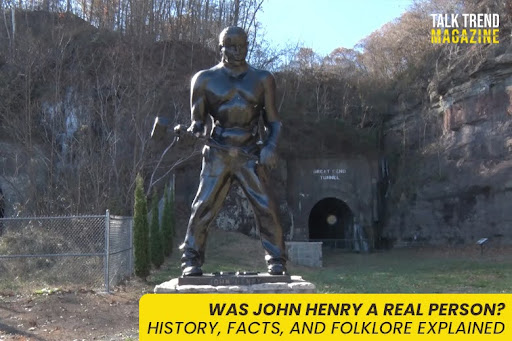

“John Henry” might be the most famous worker in American folklore—strong enough to out-swing a machine, stubborn enough to try, and tragic enough to die right after winning. But was John Henry a real person or just a tale built to rhyme? The John Henry true story question has fascinated historians, musicians, and anyone who has ever felt work speeding up while life stays human-paced. What we do know is that the John Henry legend grew out of real railroad labor in the late 1800s, where hammers rang, and new drills threatened to replace muscle. Let us separate the receipts from the riffs.
Who Was John Henry?
If you have ever heard the phrase “steel-driving man,” you have already met him. Who was John Henry in the popular imagination? He was the powerhouse of a tunnel crew—the person who drove a steel drill into rock so workers could pack the holes with explosives and blast through a mountain. That is not glamorous work; it is repetitive, dangerous, and loud. And yet, out of that gritty setting, John Henry becomes a John Henry American folk hero: a laborer with mythic strength, a man defined by pride in his skill.
The best-known story drops him into the middle of railroad expansion, when companies were racing to push tracks through the Appalachians and beyond. Then comes the scene everyone remembers: a contest—a man with hammers versus a steam-powered drill. John Henry wins, and collapses, “with his hammer in his hand,” as many versions put it. That dramatic arc—work, challenge, victory, cost—is exactly why the legend stuck.
The Legend of John Henry Explained
The John Henry legend did not arrive as a neat, single story printed in a book. It traveled the old way: voice to voice, crew to crew, generation to generation. Work songs and ballads were practical tools. They set the rhythm. They passed the time. They carried warnings. They also carried news and pride.
When people talk about John Henry folklore facts, the first fact is that there are many John Henrys—many lyric versions, many settings, many details that change depending on who is singing. Scholars point out that “hammer songs” likely shaped the tale early on, and that later ballads gathered those fragments into the narrative most of us recognize. One early written copy of a John Henry ballad is often dated around 1900 (or slightly earlier), but the singing tradition is older, tied to rail work in the 1870s.
Oral storytelling does something fascinating: it preserves the emotional truth even when the details wobble. A tunnel becomes a tunnel. A crew becomes the crew. And one extraordinary worker becomes the name we remember.
Was John Henry Based on a Real Person?
Now to the question behind the question: Was John Henry based on a real person, or is he a composite—a character assembled from many lives? Most responsible answers land in the complicated middle.
On the “real” side: the job was real, the dangers were real, and the pressure to outwork machines was real. On the “myth” side: when you ask for a birth certificate, a payroll record, a grave marker with proof, things get hazy fast. That is why people still debate whether John Henry is a real person or a myth.
A common historical position is that John Henry is not securely documented as one verifiable individual in the way, say, a president or a famous inventor would be. Instead, he likely represents (and may have been inspired by) multiple workers—especially Black laborers, including convict laborers, whose names were rarely preserved with care in official archives.
Some researchers have proposed specific candidates, but even those arguments often rely on partial records and interpretation rather than a single slam-dunk document.
In other words, John Henry may have had a human spark, but the figure we know is bigger than one file folder.
Historical Evidence Behind John Henry
When people pursue historical accuracy about John Henry, they usually start with geography first. The strongest “place-based” theories cluster around railroad tunnels in the Appalachian region and nearby projects during the late 1800s.
One famous candidate is the Big Bend (also called Great Bend) Tunnel near Talcott, West Virginia, built for the Chesapeake & Ohio Railway and completed in 1872. The U.S. National Park Service even notes how the tunnel and the ballad have become tightly linked in local memory and interpretation.
But the same body of research also shows why certainty is hard: investigators in the early 1900s–1920s era reported conflicting testimony, and railroad officials indicated that key documentation had been lost (including through fires), while also disputing whether steam drills were used at that particular tunnel. Meanwhile, another tunnel site—Lewis Tunnel in Virginia—has been argued as a better fit by some researchers, partly because of evidence of steam drill use and convict labor in that region and time.
So when you read John Henry’s true story facts, it helps to keep your “archive goggles” on the late 19th century produced records, yes—but not evenly. Working-class people, and especially Black workers and prisoners, were often under-documented, misnamed, or reduced to numbers in ledgers.
Did John Henry Really Race a Steam Drill?
Let us tackle the headline moment: Did John Henry really race a steam drill?
Steam-powered rock drills did exist in the 1800s, and by the post–Civil War period, they were becoming more practical and more widely adopted for mining and tunneling. One key development was the kind of drill associated with inventor Simon Ingersoll—designed to make drilling faster and cheaper than hand drilling, and in use by around 1870.
So the “machine” is not an anachronism. But a literal, stopwatch-style duel—one man versus one drill, winner takes all—sounds more like story logic than jobsite procedure. Real tunneling is messy: rock varies, crews rotate, tools break, and “output” is hard to measure cleanly. That is why many historians read the race as a dramatic compression of a broader reality: mechanization threatened to outpace human labor, and workers felt that pressure in their bones.
That is also why the John Henry steel driving man story hits so hard. It is not really about whether one guy beats one device in one afternoon. It is about what happens when dignity is tied to productivity, and productivity gets redefined by machines.
Why John Henry Became a Cultural Icon?
John Henry is important, not just because it is a good song.” John Henry is a symbol that carries several heavy themes at once, like labor pride and labor pain. John Henry is celebrated for skill and grit, but the ending is never a victory lap. It is a warning label.
Industrial change. The story sits right in the cultural stress point of the Industrial Revolution, when machines transformed work and reordered power.
African American work history and resilience. The ballad has long been understood as expressing both the brutality of working conditions and the refusal to be reduced to a disposable body. Encyclopaedia Britannica notes that many writers and artists interpret John Henry as a symbol of the worker’s struggle against the machine and of Black defiance under oppression.
That layered significance is the heart of John Henry folklore, meaning: it is a story that lets people talk about exploitation, pride, and loss without needing a lecture—just a melody and a name.
John Henry in Music, Literature, and Pop Culture
The John Henry folk song is the main engine of immortality here. There are “ballad” versions (often quicker, story-driven) and “hammer song” versions (often slower, rhythm-heavy, built to match the swing of work). Some scholars even point out that the song can function as a kind of workplace safety advice: do not set the pace so fast it kills you.
From there, John Henry became one of the most recognizable American folklore heroes, showing up in classrooms, children’s books, novels, and film/animation. The sheer adaptability of the story is part of its power: you can tell it as tragedy, as protest, as inspiration, or as caution—depending on what your audience needs.
And it still resonates today because the core conflict never went away. We swapped steam drills for algorithms, assembly lines for dashboards—but the same question hums underneath: How much can a human be asked to compete with a machine?
Myth vs History – Final Verdict
Here is the cleanest, fairest takeaway for John Henry history vs legend: John Henry is not historically verified as one clearly documented individual in a way that ends the debate. The strongest evidence points to a legend rooted in real labor conditions and possibly inspired by one or more real workers—then shaped, amplified, and preserved by song.
And that is not a downgrade. Legends matter because they store what official records often ignore: the feelings of the era, the tensions in the workplace, the costs paid by people whose names were not protected by paperwork. John Henry may be partly mist, but the mountain, the hammer, and the struggle are solid.


