Jabeen Sahiba

Jabeen Sahiba is a talented content writer known for creating engaging, clear, and informative content across various topics. Her versatile writing style makes her a valuable asset to any project.

You must have noticed the word “auro” online popping up in articles, blogs, or even academic circles. It sounds stylish but is also a bit mysterious. What does it really mean? The answer is interesting because Auro is used in two very different ways. In one case, it is the name of a serious educational committee that focuses on environmental and economic research. In the second, it has become a lifestyle buzzword associated with welfare, design, and a slow life.

Let us explore both sides and see why the word has garnered so much attention.

Auro in Research: An Academic Committee

In the educational world, AURÖ (written in all capital letters) is part of the German Economic Association, specifically focusing on the area of Environment and Resource Economics. This group studies how the environment, natural resources, and economy are connected. Their work examines subjects such as climate policy, resource use, and the value of protecting nature.

They also organize programs such as workshops for young researchers. For example, in February 2025, a three-day AURÖ workshop was hosted by the University of Mannheim, in collaboration with ZEW Mannheim, Germany, where PhD students and postdoctoral researchers shared their work on environmental and resource economics.

So, if you see AURÖ in academic papers, conference programs, or university contexts, it almost always refers to this scholarly committee.

Auro as a Lifestyle Idea

Outside the academic world, the word Auro (sometimes stylized as Aurö) has taken on a very different meaning. It is now used to describe the philosophy of calm, minimal, and eco-friendly living. Writers often associate Auro with Scandinavian-inspired design and welfare habits.

This version of Auro is about creating a peaceful place, using natural materials, and living in a slow, more thoughtful manner. Think about soft colors, clean lines, and plants, or a house filled with a daily routine that includes tea, meditation, or outdoor time. In this sense, Auro is less about research and more about branding and lifestyle options that bring comfort and balance.

Why Does The Word Look Unique?

The spelling of Auro gives it a special experience. Part “Auro-” comes from the Latin word arum and means “gold”, which gives the word a warm and bright meaning of value. “Ö” adds a Nordic touch, reminding people of Scandinavian culture and design. Together, they feel the word modern, stylish, and aspirational. This is perfect for brands and writers who want to express simplicity and beauty.

What Are People Saying About Others?

Writers using Auro in lifestyle usually focus on the same ideas: living with low dislocation, selecting environmentally friendly products, and detection of welfare in everyday habits. Some articles proceed further, referring to others as a movement that also combines technology for design, health, and sometimes self-care.

The details may be different, but the message remains the same: Auro represents a quiet, more thoughtful life where quality is valued above quantity.

How to use the word “Auro”?

Since “Auro” has two very different meanings, it is helpful to be clear when you use it. If you are talking about research, write Auro in all caps and add it to the environment and economic studies. If you are talking about the lifestyle, use the auro with a capital A, and add it to welfare, design, or staying slow. Providing a brief reference to your readers will make sure that they understand the meaning you intend.

Is Auro A Place?

Sometimes lifestyle writers describe Auro in a way that sounds like a destination or retreat. However, there is no city or island officially called Auro. Instead, it is more than a concept or emotion when someone says that “an Auro Retreat”, they usually mean a peaceful, simple place designed with the same calm and environmentally friendly ideas, not a real place on the map.

Why Auro Matters Today?

The reason Auro draws so much attention is that it connects with two big trends in today’s world. On the research side, climate change and resource use are crucial issues, and the Auro Committee provides scholars with an opportunity to study and address these challenges. In favor of lifestyle, people are tired of busy programs and endless consumerism. Auro lifestyle provides an alternative lifestyle routine.

In both cases, the auro is about balance. It reflects the need to take better care of the planet, while also taking better care of itself.

Final Words

Auro is a word with two very different stories. In the educational world, it is the name of an academic group dedicated to important environmental and economic research. In the second, it has evolved into a lifestyle concept that embodies simplicity, calmness, and a sustainable approach.

When using the word, it is best to add a short interpretation so that your readers know what meaning you are referring to. In this way, Auro becomes inspiring but not misleading—a word that stands for both thoughtful science and living a gentler life.

The phrase “Switching 2nd” may sound like you are listening to something while driving, and this is true, but it is more than that. Recently, people use it in sports, business, and everyday life to describe that moment when you find a stable rhythm. In simple terms, “switching 2nd” means to really go to the creation of speed and progress from warm-up mode.

Original Meaning: Changing Gear in a Car

In a manual transmission car, the second gear is available immediately after the first gear. The first gear is to move the car, but you can not stay in it for a long time. Once you are rolling, you “switch to 2nd” so the car moves smoothly and can handle greater speed. Driving instructors explain that this change is important because it provides better control and traction, especially when driving on difficult roads. If you miss it, the car can jerk or stall, which is why new drivers often miss this step so clearly.

The Modern Metaphor: A Step Forward in Life or Work

Today, people use “switching 2nd” as a way to describe moving from the starting stage into real action.

  • In sports, it is when an athlete changes pace without yet reaching full speed.
  • In work, it is when a project moves from planning to actual delivery.
  • In learning, it is when you stop practicing basics and begin creating results you can show.

Writers and coaches often emphasize that “2nd” is not about finishing or sprinting; it is about finding a speed you can sustain and build upon. It is progress that is stable and durable.

Why Does The Phrase Stick in Our Minds?

Our brain is wired to notice changes in patterns. When the speed increases, slows down, or changes direction, we naturally pay attention. Psychologists also talk about the “information gap”, that feeling of wanting to know what is coming next. “Switching 2nd” signals that something has changed, and more is about to happen. That is why the phrase is catchy in headlines, motivational posts, and pep talks—it sparks curiosity.

Not an Old Saying, But Easy to Get

Unlike older idioms, “switching 2nd” has not been around for decades. It is a fairly new phrase shaped by car culture and sports talk. But it is easy to understand because most people are already familiar with “shifting gears” as a figure of speech. Even if you have never driven a manual car, the idea of “moving into the next gear” makes sense.

How Others Explain It?

Articles and blog posts often describe “switching 2nd” as a moment of stepping up, going from phase one to phase two. Some writers focus on timing, saying that the second step is when rhythm replaces raw effort. Others describe it as part of the Internet culture, where technical terms are reused as quick, emotional signs. Both thoughts are useful, but mixing them can cause confusion. The important part is to remember: it is not just about the faster, it is about switching to a smooth, controlled motion.

When “Switching 2nd” Works and When it Does Not Happen

The value of the phrase lies in time. In a car, if you switch to another gear very quickly, the engine struggles. If you wait too long, you waste fuel and energy. In life, if you move into “second” before you’re ready, you risk burnout. But if you stay in “first” too long, you never make progress. The best moment is when you have enough grip to keep going smoothly. That is why the second gear is often linked to traction and balance, not just speed.

Everyday Examples of Switching 2nd

  • If you are learning something new, “switching 2nd” could mean finishing small projects instead of just watching tutorials.
  • If you are leading a team, it may mean transitioning from endless planning meetings to producing tangible results.
  • If you are training, it may mean transitioning from short warm-ups to steady workouts that you can repeat on a daily basis.

The key is consistency. Just like in driving, second gear is not about maximum effort; it is about keeping steady progress that you can maintain.

Why is it Popular Online?

People prefer online, attractive metaphors. “Switching 2nd” says a lot in two words: you have gone beyond the initial line, and now you are gaining momentum while under control. It reflects the speed without you already being at the finish line. That balance makes it perfect for captions, sports commentary, and motivational posts.

A Quick Test Before You Use It

Before you throw the phrase into your talk or writing, ask:

  • Have we actually moved past the beginning stage?
  • Can we hold this new pace without burning out?
  • Will my audience understand “second” in this context?

If yes, “switching 2nd” will land well. If not, you might be better off with a simpler phrase like “moving to phase two” or “shifting gears.” Those are already widely understood.

Final Thoughts

“Switching 2nd” is catchy because it is easy to picture and even easier to relate to. It describes the moment when starting effort turns into steady movement. Whether in sports, business, learning, or everyday life, it signals progress that feels smooth and controlled.

It is not about racing ahead; it is about finding your flow. Also, just like on the road, the best time to switch is when you know you can hold that pace.

If you run computers, apps, or servers at any scale, you know they never stop talking. They constantly produce logs, metrics, and traces, endless streams of raw data. Most of it piles up in expensive tools or storage systems, and managing it feels overwhelming. That is the problem Cribl, a fast-growing startup from San Francisco, was created to solve.

In 2018, three former Splunk engineers, Clint Sharp, Dritan Bitincka, and Ledion Bitincka, founded Cribl, which quickly became one of the most talked-about companies in the world, particularly in the cybersecurity sector. By 2025, it had raised over $600 million in funding, evaluated $3.5 billion, and reported over $200 million in annual recurring revenue. This gain is a massive growth for a company in such a technical field.

What does Cribl actually do?

Imagine you run a busy airport. Thousands of airplanes send signals to report fuel levels, time of arrival, and cargo information every other moment. Without traffic control, chaos would break out. Cribl plays that “air traffic control” role for computer data.

Its main product, called Cribl Stream, takes in data from any system, cleans it up, reshapes it, and sends it exactly where it should go, whether that is a security tool, a monitoring dashboard, or inexpensive cloud storage. Unlike many platforms, it does not force you to use only one vendor. Instead, it sits in the middle and works with all of them.

Cribl has added more products to cover different needs:

Edge: An intelligent, vendor-neutral agent that runs on machines or cloud systems to collect data.

Search lets you search in place for data stored in a system (like Amazon S3) without moving it first.

Lake: A central place to keep all your data, with the option to replay it into tools later.

Lakehouse: In 2025, a newer upgrade that makes searching through messy, complex data much faster.

Why Teams Use it?

There are two main reasons businesses turn to Cribl:

  1. Saving money. Data is expensive to store and analyze. Cribl can remove unnecessary fields, cut down noisy events, or turn big chunks of logs into smaller summaries. Some companies report a 41% reduction in EDR data, resulting in lower storage costs and fewer licensing fees. Additionally, they can store a full copy of everything inexpensively in cloud storage and retrieve only what is needed later.
  2. Freedom of choice. Many IT teams dislike being locked into a single vendor. Cribl lets you route your right subset of data to Splunk, Elastic, Datadog, New Relic, Sumo Logic, or even all of them at once. Each team can use the tool of its preference without forcing a one-size-fits-all approach. As CEO, Clint Sharp puts it, Cribl is not trying to replace those tools; it is there to make them work better.

How Cribl Stands Out from Competitors?

When people look for Cribl alternatives, they usually end up comparing it with big monitoring platforms like Datadog, Splunk, New Relic, Dynatrace, and Sumo Logic. The difference is that those tools aim to be the final destination for data, whereas Cribl focuses on being a neutral intermediary.

Other newer startups, such as Edge Delta and Observo, compete more directly with Cribl, offering pipelines or AI-based data reduction. Some companies also try the do-it-yourself route with open-source tools like OpenTelemetry, Fluentd, or Logstash. But DIY often means more complexity and ongoing maintenance. Cribl’s strength lies in its maturity, vendor neutrality, and comprehensive features, from collection to replay to search.

Traction, Leadership, And A Note On The Splunk Lawsuit

Cribl’s founders have strong reputations in the industry from their Splunk days, which helped attract big investors, including GV (Google’s venture fund), Sequoia, Greylock, and Tiger Global. In 2024, the company raised $319 million in Series E funding, lifting its valuation to $3.5 billion. By early 2025, it had more than $200 million in annual revenue, a milestone that few infrastructure startups achieve so quickly.

But it has not been all smooth sailing. In 2024, Splunk sued Cribl, alleging that it had copied parts of its software. A jury found some infringement but only awarded $1 in damages, basically a symbolic win. Cribl noted that the court also acknowledged the importance of “fair use” in facilitating the interoperability of systems. The lawsuit did not slow down its growth or funding.

Where It Fits in Your Tech Stack?

Cribl is not designed to replace your monitoring or security tool. Instead, it is the control layer that helps you manage all the data feeding into those tools. If your company uses several systems across multiple teams or clouds, Cribl helps reduce duplicates, minimize waste, and provide everyone with the data they actually need. Its newer Lakehouse product makes it easier to dig through messy logs when something goes wrong, without massive delays.

For startups and smaller teams, Cribl offers a “Cribl for Startups” program that provides free access to its cloud version, allowing you to experiment without incurring significant costs.

Final Thoughts

Cribl is building its success on a simple idea: companies do not want to be trapped by one vendor or forced to pay for storing data they never use. Acting as a neutral traffic controller for IT and security data, it empowers teams to decide what to retain, what to send, and what to disregard.

That clarity explains why Cribl is one of the fastest-growing startups in enterprise tech. With products like Stream, Edge, Search, and Lakehouse, it’s helping organizations cut costs, avoid lock-in, and still get full value from their data.

If you feel like your systems are drowning you in information, Cribl’s bet is straightforward: give people back control of their data, and the rest will fall into place.

Cohere is a Canadian startup founded in 2019 to make artificial intelligence accessible and useful for real businesses. Instead of building flashy consumer chat apps, Cohere focuses on safe, private AI systems that companies can run in their own secure environments.

If you want to learn what Cohere is, who is behind it, how it is different from other AI players, and whether it is worth your attention, you are in the right place.

This guide brings together the latest facts, product details, and expert coverage, so by the end, you’ll have a clear, practical understanding of the Cohere startup and its place in today’s AI landscape.

What is Cohere?

Cohere was founded in Toronto by Aidan Gomez (one of the researchers of the famous Transformer paper), Nick Frosst, and Ivan Zhang. Presently, the company works across multiple cities, including San Francisco, London, and New York. Its primary goal is to help organizations utilize advanced language models without compromising sensitive data.

Recently, Cohere raised $500 million in funding, valuing the company at $6.8 billion. This significant investment shows how much trust investors have in Cohere’s approach to private, business-focused AI.

What Does Cohere Offer?

Cohere’s products can be divided into two parts:

1. Models: These are the engines that power tasks like text generation, summarization, and search. Cohere’s most popular models are:

  • Command: Text-generation models for writing, summarizing, or answering questions.
  • Aya: Multilingual models that can understand and respond in many languages.
  • Embed & Rerank: Tools that improve enterprise search by finding the most relevant results before a model answers.

2. Platform: Cohere recently launched North, a workspace where businesses can create AI “agents.” These agents can handle multi-step jobs, such as analyzing documents or automating workflows, while remaining within the company’s secure system.

Why Do Businesses Care About Cohere?

For most companies, privacy is a huge concern. They do not want to feed their confidential information into public chatbots. Cohere solves this problem by allowing businesses to run their models in private environments. Cohere documentation emphasizes on prem, virtual private clouds (VPC), or even air-gapped (completely offline) systems.

This setup makes Cohere appealing to industries like banking, healthcare, and government, where security and compliance are non-negotiable. Cohere also supports “sovereign AI,” meaning data and models can stay within a country’s borders if required by law.

How is Cohere Different from OpenAI and Anthropic?

While OpenAI and Anthropic focus heavily on consumer-friendly products (like ChatGPT or Claude), Cohere takes a different path. It targets enterprise customers, offering them secure, customizable solutions.

Instead of just showcasing how creative a chatbot can be, Cohere focuses on practical tools, such as retrieval models (Rerank and Embed). These models improve AI assistants’ intelligence by guaranteeing they only review the most relevant documents before responding. This reduces errors and makes AI results more reliable.

Who Uses Cohere?

Cohere collaborates with some of the largest names in technology and enterprise, including Oracle, Dell, SAP, Salesforce, RBC, and Notion. Its partnership with Oracle allows customers to train and use models on Oracle’s cloud infrastructure, while Dell integrates Cohere’s AI into secure on-premises systems.

According to some reports, Cohere’s annual recurring revenue is expected to double to about $100 million by early 2025, with a target of $200 million by year-end. This demonstrates that an increasing number of companies are entrusting Cohere with critical business tasks, not just experiments.

What Are The Products Like in Real Use?

If a company wants to build a private assistant over thousands of documents, Cohere’s Command models can generate responses, while Rerank and Embed improve search accuracy. For multilingual needs, Aya enables interaction across languages.

Cohere’s North platform takes it a step further by allowing businesses to set up agents that can run complete workflows, automate repetitive office tasks, and hand tasks over to humans when needed, all while keeping data secure within company systems.

The Bottom Line: Why Cohere Matters

Cohere has built its name around trust, privacy, and control. While other AI startups compete for consumer attention, Cohere is building tools that fit directly into the workflows of large organizations. Its focus on private deployment, security, and real productivity makes it stand out in a crowded market.

If your business cares about data safety but still wants the power of modern AI, Cohere offers a serious option that’s worth exploring.

Artificial Intelligence has become one of the hottest topics of the present time, and OpenAI is the cherry on top. It is famous for creating ChatGPT and has developed from a small research laboratory into one of the world’s most valuable startups. But what really is OpenAI? How it started, how it earns money, who runs it, and why it is different from other AI companies, such as Perplexity and Anthropic?

In this article, we will walk you through OpenAI’s story – from its founder and structure to its business models, products, challenges, and future – so you get a complete picture of this groundbreaking startup.

The Beginning Of OpenAI

OpenAI started in San Francisco in December 2015. Sam Altman, Elon Musk, Ilya Sutskever, and Greg Brockman, a group of technical leaders, wanted to create artificial intelligence that would be safe and useful for all. First, OpenAI was established as a nonprofit. This idea was simple yet ambitious: to make sure that Artificial General Intelligence (AGI) would benefit humanity, not harm it.

A New Structure to Grow

In 2019, OpenAI underwent a structural change. It formed a “capped-profit” company under a nonprofit parent. This meant that it could raise money and return to investors, but with a limit on profits. The goal was to balance financial development with the original mission of security. This unique structure helped bring openIA significant investments, most notably from Microsoft, while still claiming to focus on AI development.

The Big Breakthrough: ChatGPT

The world took notice of OpenAI at the end of 2022 when it launched ChatGPT. Suddenly, millions of people were interacting with an AI that could write essays, answer questions, joke in the draft code, and even behave in human-like ways. ChatGPT went viral almost overnight.

For many people, this was the first time AI felt honest, practical, and even fun. After that, OpenAI added more products: DALL·E for image generation, Whisper for speech recognition, and Sora for text-to-video creation.

Leadership At OpenAI

Sam Altman, the young technology aficionado, became the face of OpenAI. He had already made a name for himself to run Y Combinator, a famous startup accelerator. In 2019, he stepped into the role of CEO of OpenAI. In 2023, the major drama occurred when the board briefly removed him, only to reinstate him after a few days.

Today, he continues to lead OpenAI, joined by new officers, including Fidji Simo (former CEO of Instacart), who now helps run his business and applications. This suggests that OpenAI is no longer a cutting-edge laboratory; it is becoming a seasoned corporate veteran.

How does OpenAI make money?

OpenAI generates revenue in three primary ways. First, it offers ChatGPT membership for individuals and teams. Second, it sells enterprise plans for large organizations. Third, it provides API access to developers and businesses that want to create their own app using the OpenAI model. Thanks to this mixture, OpenAI’s revenue exceeded $12 billion in 2025, with some reports stating that it could be close to $20 billion by the end of the year. Investors now value the company between $300 billion and $500 billion, making it one of the most valuable startups ever.

The High Cost of AI

Building and running of advanced AI models is expensive. OpenAI spends billions on computing power every year. To control these costs, it is planning huge new data centers and even searching for custom chips manufactured with partners such as Broadcom and TSMC. OpenAI has begun renting computational power from various providers, including Microsoft, Google, and CoreWeave. By doing this, the company is expected to stay independent and reduce dependence on any single partner.

Large deal and acquisition

In 2025, OpenAI made headlines by purchasing a hardware startup, “io,” founded by designer Joni Ive, for $6.5 billion. This was a major step towards creating AI hardware in-house. At the same time, OpenAI signed a $200 million deal with the US Department of Defense and collaborated with the UK government to integrate AI equipment into public services. It also launched a $50 million fund to support nonprofit and community projects, indicating that it still wants to focus on the public good.

Challenges and controversies

Like any fast-growing company, OpenAI has faced its share of problems. Authors, publishers, and media companies have filed a lawsuit for the use of their content in training data. While conducting a profit inspection, its shift towards a public benefit corporation has also raised questions about the government. Within the company, a heated debate has been ongoing regarding security, morality, and workplace tension. These disputes remind people that AI is not only a technical challenge, but also a social one.

Push The Boundaries

Despite the challenges, OpenAI continues to move forward. In 2025, its model showed progress in solving advanced mathematics problems, even at the level of an Olympiad medal winner. It is also developing new products, such as an operator and AI agents, that can use websites and apps on your behalf. The company’s long-term ambition is clear: to create an AGI that can argue, act, and learn from today’s chatbots.

OpenAI vs. Perplexity vs Anthropic

OpenAI is not just an AI startup making waves. Perplexity focuses on having an “answer engine“, combining AI with live web results and giving clear quotes. It is particularly popular with researchers who want verified sources. On the other hand, Anthropic highlights security and reliability. Its Claude model is designed to follow a strong railing and handle very long documents, making them attractive to businesses and professionals. Compared to these, OpenAI is broader. It offers a wide range of tools, from creative apps like DALL·E to enterprise-level AI infrastructure. However, Perplexity is about reliable answers, Anthropic is about safe, steerable assistants, and OpenAI is about building an all-in-one AI platform at a massive scale.

The Road Ahead

OpenAI is one of the most influential companies in the world, having grown from a mission-driven laboratory. It is shaping how students learn, how businesses work, and how governments provide services. However, questions remain: Can it strike a balance between profit and responsibility? Can it keep costs under control as models become more powerful? And will it be right for the founder’s mission to make AI safe? These challenges are opening faces as they step into the future of artificial intelligence.

When you hear the phrase “Forbes startup,” it instantly sparks curiosity. Forbes has become one of the most trusted platforms for recognizing new businesses, visionary leaders, and breakthrough innovations. Being featured in Forbes is like getting a big stamp of approval for a startup or founder. Lists such as 30 Under 30” or “Fintech 50 highlight people and companies that are making a real impact. When someone gets on these lists, it shows the world that their hard work is paying off. It also makes investors, partners, and new customers take them more seriously, which often leads to even bigger opportunities.

In this article, we will explore what “Forbes startup” really means, the different ways Forbes shines a spotlight on growing companies, how you can position your business for such recognition, and the best ways to make the most of it once you get there.

Understanding Forbes Startup

When people discover “Forbes Startups”, they are usually trying to understand how Forbes has covered startups, what kind of recognition exists, and how a young company can break into that conversation. Think of Forbes as a newsroom and a set of editorial franchises that regularly take promising companies and leaders to the cover.

The Signature Forbes Startup List

Forbes publishes the running lists and features that spotlight highly affected companies. “America’s best startup employer” ranks private companies based on reputation, employee satisfaction, and development. Another famous franchise is “Next Billion-Dollar Startups”, which covers 25 venture-backed companies, believing that there is likely to be a unicorn among them. At its top, Forbes also highlighted areas with lists such as “Fintech 50” and “AI 50“, where being featured often catches a startup in mainstream visibility.

30 under Forbes 30: Opened Entry Points

One of the most visible paths for young founders is Forbes’ “30 under 30.” It celebrates innovators under the age of 30 in various industries. The enrollment process is open to the public, allowing you to nominate yourself or someone else, and it is free to apply. The selection highlights the impact, speed, and leadership of the average individual. For young entrepreneurs, this list is often the first significant form of recognition that accelerates reliability.

Editorial Coverage Vs Forbes Council

Forbes offers “Forbes Council”, which are paid, invitation-only communities for officers. These memberships allow you to network and publish trusted expert articles on forbes.com, but they are not editorial coverage. Councils are seen as professional communities with publishing allowances, while Forbes’ list and features are strict editorials. Knowing this distinction can help the founders avoid unrealistic expectations.

How Can Startups Get Forbes Coverage?

Forbes’s works in journalism are driven by newsworthiness. Agencies can pitch quick wins, but journalists can focus on startups that can support their claims with data, traction, and unique insights. Pitches that rely on publicity or general claims are usually overlooked. Instead, the strongest stories around innovation, proven customer impact, or development milestones can be the center that can be independently verified.

The Changing Media Landscape

Forbes, like several other outlets, is tightening its editorial standards. Recent industry changes mean that contributor-driven coverage is being investigated more closely, and staff-operated reporting carries more weight. Startups expecting to be featured need to adjust them now. Now, they require strong proof points, better storytelling, and alignment with editorial values.

Mapping Your Story in The Right Forbes Window

Startups should identify that the Forbes platform best fits their story. For example, a startup with an AI infrastructure breakthrough can aim to be on the “AI 50” list, while a fast-growing consumer app with a strong employee culture can be a better fit for “best startup employers.” By studying recent honors, the founders can understand what kind of traction, revenue, or user development resonates with Forbes editors.

Preparing Evidence That Counts

Forbes editors and journalists are skilled at seeing meaningful stories, with a focus on customer success, retention data, revenue growth, or industry-wide impact. For less than 30, they see effects, leadership, and innovation. For sector-specific lists, such as the Fintech 50, they focus on funding rounds, adoption rates, and competitive benefits. The strongest applications and pitches come from founders who begin to collect this data quickly.

Creating most of the Forbes Council

If you join a Forbes Council, think of it as a valuable platform—not a shortcut to press coverage. Publishing thoughtful, helpful articles can help educate potential customers, highlight your expertise, and build a consistent narrative around your startup. When used strategically, the council membership complements the editorial characteristics of Forbes, but it should never be confused with them.

Maximizing the Recognition

To be featured by Forbes is just the beginning. Founders should enrich their recognition by updating their websites and showcasing achievements in conversations with investors and potential hires. For employer-centric lists, displaying prizes on career pages can promote recruitment. For industry-focused recognition, incorporating it into sales decks and marketing materials improves your authority area.

Final Words

“Forbes Startup” is not a label that you can buy. It is the recognition that you earn through traction, results, and storytelling. The most effective approach is to create the actual momentum, understand that Forbes opportunities align with your stage, and connect with editors on substance rather than spin. With preparation and patience, when the Forbes window opens, you will be ready to take maximum advantage of it.

If you have ever ordered food on your phone and have seen it traveling on a map towards your home, you have probably used DoorDash. The largest food distribution company in the United States, which was launched as a small student project, has grown.

This blog is the story of how DoorDash started, how it works, how it grows, and what comes next.

From The Idea of ​​a Campus to a Nationwide Company

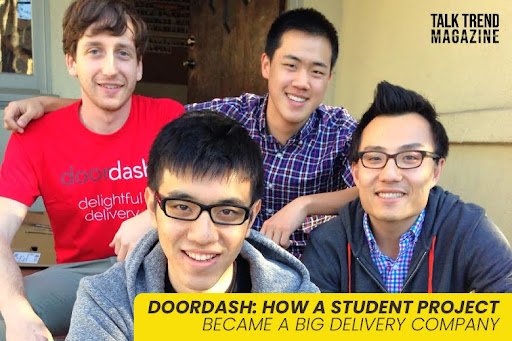
DoorDash began in 2013 when four Stanford students, Tony Xu, Stanley Tang, Andy Fang, and Evan Moore, decided to deliver food for small restaurants. They first created a simple website called PaloAltoDelivery.com and spread the word by distributing flyers. Later that year, they joined the Y Combinator Startup Program and changed the name to DoorDash.

Their promise was simple: to help local restaurants provide food without appointing drivers or forcing them to create new technology. The idea spread quickly. By 2019, DoorDash had become the number one food delivery company in the United States.

Wanted to Fix The Problem

Restaurants often struggled with delivery as it was expensive and complex. DoorDash developed technology that could match restaurants, customers, and delivery drivers (called “dashers”) in real time. The company saw itself not only as a “food app” but also as a logistics business. A company that resolves the challenge of transferring things from Point A to Point B.

How Does it Earn Money?

DoorDash earns money in some ways. Every time a person orders through the app, the restaurants pay a fee. Customers also pay service and distribution fees when they order. Dashers are paid per delivery and can also receive tips.

The company also offers membership plans, such as DashPass, which allows customers to pay a monthly fee to receive free or discounted delivery. Additionally, restaurants can pay for advertising within the app to appear more frequently in customer discoveries.

Smart Moves That Helped to Grow DoorDash

Two big choices made DoorDash stand out. First, it focused on suburbs, rather than just big cities. Other companies thought that the suburbs would not be profitable, but DoorDash proved them wrong. Second, it expanded beyond the restaurant. Today, customers can order grocery items, convenience items, alcohol, and even household items.

The company also introduced facilities like DoubleDash, which allows customers to order from two places in a single delivery without paying additional fees.

DoorDash by Numbers

In December 2020, DoorDash became public on the stock market with one of the largest IPOs of the year. During the COVID-19 pandemic, when demand for delivery skyrocketed, the company experienced even faster growth. Today, it controls more than half of the American food distribution market.

By 2025, DoorDash continued to increase its revenue for more frequent orders and better distribution efficiency. Its growth story shares some similarities with Instacart’s startup, which also began as a small idea and grew into a household name during the pandemic.

Competitors Keep The Pressure on

DoorDash is a leader, but the competition is difficult. Uber Eats is its most significant rival, while Grubhub still holds a small market share. Recently, Grubhub partnered with Amazon Prime to offer free delivery to Prime members, which accelerated the competition.

To stay ahead, DoorDash invests in membership, partnerships with retailers, and advertising services for restaurants.

Legal Battle on Driver’s Status

The most significant debate around DoorDash is whether the dashers should be considered employees or independent contractors. In California, voters approved Proposition 22 in 2020, which allowed drivers to remain independent while receiving some benefits.

In 2024, the California Supreme Court confirmed this law. For DoorDash, it was a significant win, as it keeps the cost low and preserves the flexible working style that many Dashers prefer. However, critics argue that the drivers deserve more protection.

Why The Restaurant Liked DoorDash?

The small restaurant quickly saw the value of DoorDash. It provided them with an easy way to reach new customers, set up online menus, and start delivering food without needing to hire staff or purchase vehicles.

DoorDash worked closely with the restaurant owners, making their needs and building tools easier by listening to their feedback. Focusing on supporting small businesses, whether from home or small restaurants, helped the company gain confidence and expand rapidly.

The Money Challenge

Food distribution is not a high-profit business. Costs like driver pay, customer support, refunds, and promotions eat into earnings. DoorDash has worked to improve its margin by combining orders, reducing refund rates, and adding new revenue streams such as advertisements.

Nevertheless, keeping customers, restaurants, and drivers all satisfied is a difficult balancing task. If the fees increase too high, people can stop ordering. If the payment falls, the Dashers can leave. Additionally, if the commission increases, restaurants may seek alternative options.

What is Next For DoorDash?

DoorDash aims to become more than just one food distribution app. It aims to be a platform for all types of local shopping, including grocery items, pharmacy items, and household essentials. It is also planning to expand internationally, although this development is still smaller than its presence in the U.S.

The company’s success will depend on how it adapts to changes in regulation, competition, and customer spending habits.

In Summary

DoorDash’s journey shows how a simple idea to help small restaurants deliver food can turn into a huge company when combined with technology and determination. By solving the delivery problems, step by step, DoorDash converted the leading distribution platform in the U.S. from a student project. Its story proves that with the right focus and perseverance, even everyday problems, such as getting dinner delivered to your door, can inspire billion-dollar businesses.

When people discuss artificial intelligence today, names like ChatGPT often come to mind first. But another company, anthropic, is quickly making a name for itself. It was established by siblings Dario and Daniella Amodei in 2021, with a team of pre-openiAI researchers. The greatest goal of Anthropic is to create AI that is not only powerful but also safe and reliable. 

Unlike many Silicon Valley startups, Anthropic has been established as a public benefit corporation, meaning that helping society is part of its official mission, not just one that comes later.

Meet Claude: Anthropic AI Assistant

The major product of Anthropic is Claude, a family of AI systems that can read, write, and talk with users in natural language. The first Claude model surfaced in 2023, and since then, Anthropic has released improved versions, culminating in the latest Claude 4 models in 2025. These include Opus 4 (the most potent version) and Sonnet 4 (a more inexpensive and versatile option).

Claude can do much more than chat. Users can upload documents, such as PDFs and spreadsheets, for analysis, create shared work using a feature called Artworks, and even interact with Claude using voice mode. In other words, it is being developed with just one chatbot as part of a comprehensive digital work assistant.

What Makes Anthropic Different: “Constitutional AI”

One thing that separates Anthropic is its training method, called Constitutional AI. Generally, AI models learn from huge amounts of human responses. But Anthropic added a twist: He taught Claude to review his own answers based on a written “Constitution”, a set of rules and principles, such as honesty, accountability, and safety.

This approach helps reduce harmful or biased reactions while maintaining Claude’s utility in real-world functions. In fact, Anthropic published even those principles that use it so that the public can see how Claude is directed. Think of it as giving AI a moral compass to follow.

Get The Public for Guidance

Anthropic also believes that decisions about AI values ​​should not be made only by technical companies. In 2023, the Collective Intelligence Project asked around 1,000 Americans about the rules the AI system should follow. Answers helped shape how Claude reacts to people.

Although it does not solve the big question of “who decides what AI should believe,” it shows Anthropic is willing to let society have a voice in the process.

Power Meets Practical Use

Do not make a “security-first” mistake for “slow”. The latest versions of Claude are designed to handle difficult tasks, from coding projects to long reports. The most advanced version, Opus 4, can focus on complex tasks for extended periods, while Sonnet 4 offers companies a more affordable yet still competent option.

Independent reviewers often note that Claude is powerful in understanding and can now work with images, text, and voice. That makes it a competitor not only to ChatGPT but also to AI models from Google, Meta, and other tech giants.

Big Money, Big Valuation

The rise of Anthropic has not been unnoticed by investors. The company has raised billions of dollars since its launch. Reports in 2025 suggest that it is close to achieving another $5 billion round under the leadership of Iconiq Capital, which would value the startup at around $170 billion. This value is a shocking number, especially considering the company is not even five years old.

Picking Its Investors Carefully

The high level of interest has created a unique problem: many people want to invest. Recently, Anthropic stated that it may limit or reject investment from special-purpose vehicles (SPVs) to buy hot startups with funds raised by groups of investors. The company aims to keep its investor list simple and transparent, especially given the high demand. In short, Anthropic has become so popular that it can choose its investors rather than the other way around.

Not Just for Consumers

Anthropic does not only focus on everyday users who chat with clouds. It also has a strong business strategy. Companies can use Claude through an API, allowing them to integrate AI into their own applications and workflows. Anthropic also runs a startup support program, which gives early-phase companies community support through credit, resources, and venture capital partners.

In this way, Claude becomes an integral part of how business works, not only a device for individuals. It is a playbook that reflects the strategies of giants such as Amazon Web Services and Microsoft, and this is one of the reasons Anthropic has grown so quickly.

Leadership And Culture

The top of the Anthropic is Dario Amodei (CEO) and Deniella Amodei (President). The leadership team consists of experts in AI security, interpretation, and large-scale model development. The one who stands out is the balance of caution and ambition. They want AI to combine with safe and human values, but they also quickly ship new features to stay ahead in competitive AI races.

Why Anthropic Matter?

In a few years, Anthropic has evolved from a small, well-known startup to one of the world’s most valuable AI companies. A combination of state-of-the-art technology, a strong focus on 

security, and deep investment from investors has made it a central player in the AI Boom.

As AI continues to integrate into everyday life, from work to entertainment and research, Athropic’s vision for creating trusted AI encompasses not only how we use these devices but also how we feel about them.