
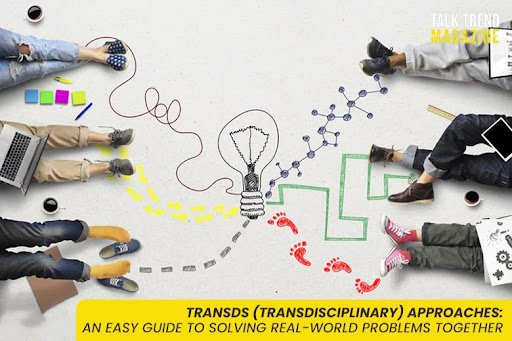
When people use the word “transds,” they are mostly talking about transdisciplinary ways of working. Simply put, this approach brings together experts from various fields, as well as those directly affected by this issue. Instead of competing to determine whose approach is correct, the group focuses on creating a shared solution that actually works in everyday life.
This method of working is now serving as a bridge, addressing climate change, urban health, education, and numerous other challenges, as it combines strong scientific research that people truly need.
Knowledge Beyond Disciplines
A transdisciplinary approach means more than just connecting different academic subjects. It also includes non-educational partners such as community members, NGOs, businesses, and governments. Everyone participates in defining the problem, deciding what success should look like, and the solutions should be tested in real-world settings.
The purpose is not only to gather information, but also to provide practical and useful insights. Field guides from leading universities describe this balance as “scientific rigor meeting societal relevance.”
How Does it Differ From Multi- And Inter-Disciplinary Work?
It is helpful to see how transds differs from other approaches. In multidisciplinary work, different fields study the same topic independently, and their results are presented side by side.
In interdisciplinary work, different fields mix their methods and ideas to form a coordinated whole. Transds goes further by including non-academic voices and focusing on one real-world solution that no single field could create on its own.
Public health and education research often highlight this difference because it has proven so important in practice.
Why do Transds Approaches Succeed?
One reason transds approaches are powerful is that solutions are easier to adopt when the people who will use them help design them. These teams are also better at spotting trade-offs early, whether social, technical, economic, or environmental, so that fixing one problem does not create another.
Current research emphasizes that including communities and practitioners is not just a “bonus,” but necessary for dealing with today’s overlapping crises.
The Process as a Cycle
This process can be considered as a cycle rather than a straight line. It begins with a shared problem that matters to those involved. Instead of starting with a method, the team begins with a question and considers who can benefit, who can lose, and what “better” really means for all.
After that, researchers, physicians, and community members collaborated to design the plan together. They agree on roles, deadlines, morality, and decision-making processes, which later prevents conflicts and respects the experience as a valuable form of knowledge.
Once the plan is in place, teams deliberately blend methods to achieve their goals. Surveys, experiments, design sprints, and participatory workshops are combined to gather evidence from multiple sources, aiming for proper integration rather than merely parallel work.
Testing in Real Life
The next phase is testing in the real world. The solutions are piloted in accurate settings where they are used, such as neighborhoods, schools, clinics, or natural areas.
In this way, the group learns what works, what breaks, and why, and then adjusts accordingly. Research in urban projects has shown that this stage is often what transforms an idea into something people will actually use.
Finally, there is a stage of reflection and sharing. Teams review what worked and what did not, and then share results in many forms: not just academic journals but also toolkits, community meetings, and policy briefs that reach different audiences.
Examples of Transds in Action
There are many clear examples of transds approaches in action. In cities facing dangerous heat, teams have combined scientific data with community input to co-design solutions such as tree planting, shaded bus stops, and reflective surfaces.
In Europe, architects, social scientists, and residents have collaborated to create climate-resilient green spaces that towns can expand and adapt to. Projects utilizing nature-based solutions demonstrate the importance of integrating ecology, planning, design, and social science, as projects often fail when applied in practice without this approach.
Research on public green spaces and health also highlights that planning must go beyond one-time fixes and instead place health at the center, something that is only possible through transdisciplinary collaboration.
Challenges and how to solve them
Of course, this approach is not without challenges. It often requires more time at the beginning because people use different professional languages, and power imbalances can arise. The solutions, however, are straightforward: agree on a shared language, establish clear decision-making rules, compensate community partners fairly for their time, and build in room for adjustments instead of expecting a perfect rollout.
Leading guides emphasize that evidence and lived experience must be treated as equals in order for the final solution to earn trust and long-term use.
When to Choose a Transds Approach?
A transdisciplinary approach is most valuable when problems cross boundaries and solutions must be effective in real-world applications, such as those related to climate adaptation, food systems, public health, or AI ethics. If the problem only needs a narrow technical fix, then a single-discipline or interdisciplinary method may be quicker.
However, when people, policies, and places all need to align, transds is usually the best choice. Research over many decades has shown that transdisciplinarity goes beyond traditional boundaries by turning knowledge into action.
The Takeaway
In the end, transds approaches make it possible to turn good ideas into working solutions. They start with a shared problem, bring together different types of knowledge, including the voices of those who will live with the outcome, and test solutions in real-world settings. For teams that want results that last, rather than just publications, transds is becoming the default path for complex human challenges. Both research and practice indicate that this approach is the future.
