

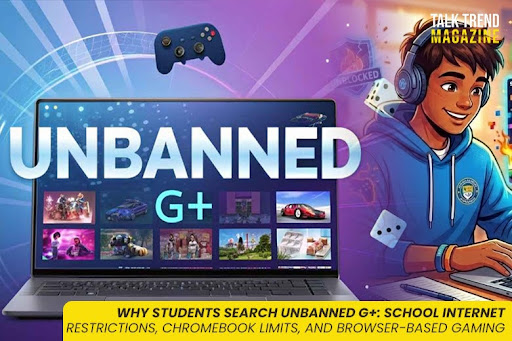

Students do not search “Unbanned G+” because it is a real brand or an official platform. They search it because it functions like a shortcut keyword that often leads to what they actually want: browser-based games that still load on restricted school networks.
In many schools, entertainment categories like gaming and streaming are restricted for safety, focus, bandwidth, and compliance reasons. At the same time, students still want quick ways to relax during breaks, free periods, or after assignments. That tension creates a predictable behavior pattern: students search for terms that might surface accessible game hubs.
This article explains the real reasons behind the trend in three parts:
- School internet restrictions
- Chromebook limitations
- Browser-based gaming behavior
First, what “Unbanned G+” signals in student language
Before we break down the reasons, it helps to understand the phrase itself.
Most SERP competitors describe Unbanned G+ as a collective label used for unblocked browser game hubs on restricted networks, especially school Wi-Fi. It is not a single stable website and not an official product.
Students often use “unbanned” the way they mean “unblocked.” That difference matters because it explains why the keyword sounds odd, but still spreads fast.
In student logic, the phrase basically means:
- “The game hub that still works here”
- “The one that is not blocked on school Wi-Fi”
- “The browser games I can play without installing anything”
1) School internet restrictions
Why schools restrict sites in the first place
School internet restrictions are not random. Schools block categories to:
- keep students focused during instructional time
- reduce exposure to unsafe content
- manage bandwidth and performance
- comply with education safety rules and policies
It is common for schools to block entire categories like gaming, streaming, social media, and proxy tools as part of broader student safety and instructional focus policies.
From a student perspective, though, the experience is simple:
- “This site worked at home.”
- “It does not work at school.”
- “I need a different search term.”
That is where keywords like “Unbanned G+” emerge.
How restriction feels to students (the behavior loop)
Here is the typical loop that creates “Unbanned G+” searches:
- A student tries a popular game site. It is blocked.
- They try another well-known unblocked site. That is blocked too.
- They ask friends or search TikTok/Discord for “what works.”
- Someone says: “Search unbanned g+.”
- The phrase becomes the shared shortcut.
This is exactly the kind of “persistent gap” some competitors mention: admins restrict entertainment, users still want break-time access, and new hubs keep appearing because demand stays constant.
Why gaming gets blocked more aggressively than other categories
Gaming is blocked hard because it combines multiple concerns:
- distraction risk (students switching tabs during class)
- heavy resource usage (ads, scripts, multiplayer traffic)
- content variability (some games include chat, violence, gambling-like mechanics)
- unknown ad networks (riskier than static educational content)
Even when a game is harmless, the site hosting it may include aggressive ads or trackers, which increases the chance it gets filtered later.
Why students search “unbanned” instead of “unblocked”
“Unblocked games” is a logical keyword, but “unbanned” spreads because it sounds like a stronger promise: access restored, restrictions removed, “the working version.”
Some SERP content even frames Unbanned G+ as the “latest hub that still works here,” which shows how the term is used socially.
Students are not trying to be technically correct. They are trying to find a phrase that returns results.
2) Chromebook limitations
Chromebooks are one of the biggest drivers of this keyword trend because they shape what students can do.
Chromebooks are browser-first by design
A Chromebook is optimized around the browser. That is great for schoolwork and cloud apps, but it also means entertainment naturally shifts toward browser-based content, including games.
So even if a student would prefer to download a game, on a school Chromebook that usually is not realistic.
School Chromebooks are typically managed devices
Many schools manage Chromebooks centrally. That management often includes restrictions such as:
- limiting which apps can be installed
- forcing or blocking specific apps
- controlling permissions and settings
- locking down extension installation
Google’s own admin documentation describes how admins can force-install apps, allow-install from managed Google Play, pin apps, or block installs, which highlights how controlled these environments can be.
From the student’s view, this translates into:
“I cannot just install a game.”
That limitation pushes students toward browser games and toward searches like “Unbanned G+.”
Why students do not rely on app stores at school
Even if a Chromebook supports Android apps, the ability to install them depends on admin policy. If installs are blocked, the “app route” is a dead end.
So the fastest, most reliable entertainment option becomes:
- open a tab
- click play
- close tab
- return to homework
That behavior matches browser-based gaming perfectly.
Why Chromebooks create “quick session” game demand
Chromebook use in school is often structured around:
- short breaks
- supervised classes
- time-limited free periods
- shared spaces
This environment rewards games that:
- load quickly
- require no login
- can be played in 2 to 10 minutes
- do not require saving progress
Competitor content frequently calls out that these hubs “work well on Chromebooks” specifically because they rely on standard browsers and lightweight game tech.
3) Browser-based gaming
Browser games match student constraints perfectly
Browser-based games have three advantages that map directly to school reality:
- No installation
- Low friction (search, click, play)
- Fast exit (close tab, done)
That is why Unbanned G+ is commonly described as a hub for browser-playable games that fit school and work environments.
Why “no installs” matters more than people think
On a personal PC, downloads are normal. On school devices, downloads are often:
- blocked
- restricted by permissions
- monitored
- not worth the risk of breaking policy
So “no install” is not just convenience. It is the only option that fits the environment.
The “break-time reset” effect
A lot of students are not searching because they want hours of gaming. They want a mental reset between tasks.
Some competitor pages explicitly position these hubs as short-break entertainment for students, and even for workers during lunch, because the format is lightweight and quick.
Whether or not you agree with gaming at school, the psychology is simple:
- school day is long
- attention gets tired
- quick play feels like a reset
- students search for what works
Why the keyword spreads faster than any single game site
This is one of the most important ranking insights.
Competitors point out that when one URL gets blocked, clones or mirrors appear and students share the “fresh” replacement.
That creates a situation where:
- specific sites come and go
- the keyword stays
- the community learns “search this phrase”
So “Unbanned G+” becomes a reusable search label, not a stable destination.
Why schools often catch up eventually
Most school filtering systems adapt. When a hub becomes popular, it draws attention, and it may eventually be blocked like the others.
That is why the trend does not die. It cycles:
- a hub works
- it spreads
- it gets blocked
- students search again
- new hubs appear
- The keyword stays
Competitors describe this as an ongoing “gap” between restrictions and break-time demand, which is a useful framing for your content.
FAQs
Why do students search “Unbanned G+” instead of “unblocked games”?
Because the phrase spreads socially as a shortcut keyword, it often points to the latest browser game hub that still loads on restricted networks.
Do Chromebooks cause this trend?
They strongly contribute. Managed Chromebooks often limit installs and push students toward browser-based options, which aligns with “Unbanned G+” style game hubs.
Are school internet restrictions normal?
Yes. Schools commonly block categories, including gaming and streaming, for policy, safety, and focus reasons.


