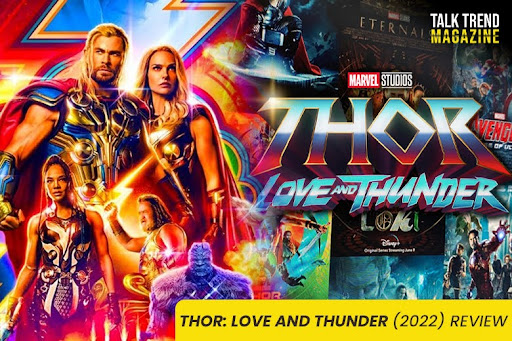
A Film Caught Between Sincerity and Self-Parody
When I first watched Thor: Love and Thunder in 2022, the immediate reaction was not disappointment, nor enthusiasm. It was confusion.
This is a film that swings between genuine emotional weight and full-blown parody, sometimes within the same scene. Four years later, revisiting it with distance from the opening weekend noise, the experience is clearer.
The strengths are visible. The weaknesses are structural. And the conversation around it has often been louder than the film itself.
Directed by Taika Waititi and starring Chris Hemsworth, Natalie Portman, and Christian Bale, this fourth Thor installment arrived with high expectations following the success of Thor: Ragnarok and the emotional aftermath of Avengers: Endgame.
It grossed approximately $760 million worldwide against a reported production budget of around $250 million, making it financially successful. Critically, however, it landed at roughly 63 percent on Rotten Tomatoes, placing it firmly in divisive territory.
This review draws from my own viewing experience first, then situates the film within the broader critical and audience conversation.
Quick Verdict
Rating: 6.5 out of 10
This is a visually imaginative but narratively compressed sequel that struggles to balance absurdist comedy with genuine tragedy.
Who will enjoy it?
Viewers who liked the comedic tone of Ragnarok, fans of cosmic Marvel spectacle, and audiences less concerned with tonal precision.
Who may not
Those expecting a darker adaptation of Gorr the God Butcher, viewers fatigued by self-aware MCU humor, or audiences wanting more emotional depth.
Is it worth watching in 2026?
Yes, but with adjusted expectations. It plays better as a quirky, emotionally sincere fairy tale than as a major mythological epic.
If you are searching for a “Thor Love and Thunder review Rotten Tomatoes” perspective, the consensus captures the division but not the deeper structural issues.
Similarly, the “Thor: Love and Thunder review Guardian” criticism about tonal chaos touches on something real but stops short of analyzing why the structure amplifies that chaos.
Plot Overview
Before breaking down key story developments, it’s important to understand how the narrative is structured and what emotional arc drives it. The film balances cosmic spectacle with intimate themes of grief, love, and rediscovered purpose.
Spoiler-Free Summary
Thor is physically restored but emotionally unmoored following the events of Endgame. He drifts between battles with the Guardians of the Galaxy, seeking purpose rather than glory.
Jane Foster reenters his life, now wielding Mjolnir as the Mighty Thor while secretly battling advanced cancer.
Meanwhile, Gorr the God Butcher embarks on a crusade to eliminate gods after losing faith in them and losing his daughter.
The story builds toward a confrontation centered on Eternity, a cosmic entity capable of granting a single wish.
Spoiler Section
Gorr seeks Eternity to resurrect his daughter. Thor ultimately chooses compassion over vengeance, persuading Gorr to abandon hatred. Gorr dies but his daughter is restored. Thor adopts her.
The character often searched as “Thor: Love and Thunder daughter” refers to Love, Gorr’s resurrected child, who now fights alongside Thor. She embodies the film’s central theme: grief transformed into care.
Experience Watching Thor: Love and Thunder
The first act moves briskly, perhaps too briskly. Emotional stakes are introduced but not allowed to settle. Jane’s diagnosis scenes are sincere, but moments later the film pivots into broad physical comedy.
The black-and-white Shadow Realm sequence is visually controlled and tonally focused. It is arguably the film’s strongest stretch. For a brief period, the movie feels disciplined, almost haunting. That discipline fades when it returns to brightly colored spectacle and improvisational humor.
The issue is not that comedy exists. It is that comedy overwhelms rhythm. The film rarely lets silence linger.
How Other Critics and Audiences Responded
After assessing it personally, revisiting broader discourse is good when you are reviewing a big movie
Rotten Tomatoes
With a score hovering around the low 60s, critics were split. Praise centered on performances and energy. Criticism focused on tonal imbalance and underwritten villainy. The aggregate reflected neither disaster nor triumph.
The Guardian
The Guardian’s review criticized the film’s chaotic tone and argued that Waititi’s improvisational style lacked restraint. While sharp in its observations, it framed the film as indulgent rather than examining structural compression.
YouTube Critics
Many long-form YouTube analysts emphasized editing issues. They pointed out abrupt transitions, truncated character arcs, and a feeling that major material had been removed. Several referenced reports of longer cuts that were trimmed down, arguing the two-hour runtime may have harmed narrative cohesion.
Reddit Discussions
Reddit reactions were polarized. Some users defended its sincerity and emotional ending. Others called it a parody of itself. A consistent theme was frustration over Gorr’s limited screen presence.
What is often missed in these conversations is not simply that the tone is inconsistent. It is how editing and runtime intensify that inconsistency.
Why Did Thor: Love and Thunder Get Such Bad Ratings?
The question frequently appears in search results: “Why is Thor: Love and Thunder so bad?”
It is not universally bad. It is uneven. The reasons behind the backlash can be broken down clearly.
Tone Overload
Waititi’s comedic sensibility worked in Ragnarok because it contrasted with darker stakes. In this film, nearly every emotional beat competes with a punchline. When humor becomes constant, it ceases to feel sharp.
Underused Villain
Christian Bale delivers a restrained and haunting performance as Gorr. His introduction is powerful. However, much of his god-slaying occurs off-screen. This reduces the sense of escalating threat. In the comics, Gorr’s campaign spans centuries. Here, it feels condensed.
Emotional Undercutting
Jane’s cancer storyline is handled respectfully in isolated scenes. But the narrative often pivots away before emotional resonance fully lands. The contrast between chemotherapy sessions and screaming goats exemplifies the film’s tonal dissonance.
Comparison With Ragnarok
Thor: Ragnarok felt fresh in 2017. By 2022, audiences expected evolution, not amplification of the same formula. Instead of deepening Thor’s mythology, Love and Thunder heightens the comedic extremes.
Is Thor: Love and Thunder a Hit or Flop?
Financial data matters.
Opening weekend domestic gross reached roughly $144 million. Worldwide, the total surpassed $760 million. With a production budget near $250 million and estimated marketing costs pushing total expenses toward $350 million or more, the film likely turned a moderate profit.
By strict box office standards, it was a hit.
By critical standards, it was controversial.
Therefore, when asking, “Did Thor: Love and Thunder hit or flop?” the answer is straightforward: financially successful, creatively polarizing.
Performances in The Movie
The performances in Thor: Love and Thunder carry much of the film’s emotional weight, especially when the script wavers between sincerity and satire. While the tone fluctuates, the cast consistently commits to their roles with conviction.
Chris Hemsworth
Hemsworth commits fully. However, the character occasionally slips into caricature. In later interviews, Hemsworth acknowledged that the comedic direction may have gone too far. His self-awareness reinforces a common critique that Thor edges toward parody.
Natalie Portman
A common search question is “Why did Natalie Portman quit Thor?”
She did not quit. After Thor: The Dark World, her involvement ended due to contract completion and shifting creative direction. She returned when presented with the Mighty Thor arc.
Her performance here is grounded and emotionally credible. She anchors the film when it allows her to.
Christian Bale
Bale’s Gorr is restrained rather than flamboyant. The performance suggests depth that the screenplay does not fully explore. He elevates scenes through stillness and menace.
Supporting Cast
Valkyrie is competent but underwritten. Korg occupies significant comedic space. Zeus is intentionally exaggerated, though his broad characterization contributes to tonal imbalance.
Technical Evaluation
Cinematography
The Shadow Realm sequence stands out. The monochrome palette creates stark contrast and thematic gravity. Elsewhere, digital backdrops occasionally feel artificial.
Editing and Pacing
The sub-two-hour runtime is unusually short for a modern MCU installment. The result feels compressed. Character motivations appear abbreviated. Gorr’s arc especially suffers.
Score and Soundtrack
Guns N’ Roses tracks inject energy but sometimes feel nostalgic rather than narratively essential.
Visual Effects
Some sequences display polished effects. Others appear inconsistent, contributing to criticism that production may have been rushed.
Where It Fits in the MCU
Phase Four of the Marvel Cinematic Universe experimented with tone and scale. Compared with Doctor Strange in the Multiverse of Madness, which leaned into horror stylization, Love and Thunder pursued absurdist comedy.
Post-Avengers: Endgame, audiences recalibrated expectations. The stakes of the Infinity Saga had concluded. Many viewers wanted either bold reinvention or emotional depth. Instead, this film felt like heightened repetition.
A frequent search asks, “Which Thor movie did Chris Hemsworth not like?”
Hemsworth has openly expressed dissatisfaction with Thor: The Dark World, citing creative limitations at the time. Ironically, Love and Thunder faced criticism for the opposite reason: excess rather than restriction.
Audience Reaction vs Critics
Rotten Tomatoes reflects mixed critical response. CinemaScore audiences graded it around B+, indicating general satisfaction but not enthusiasm.
Online discourse magnified negativity. Streaming rewatch culture has softened some opinions. With distance, the film feels less catastrophic and more uneven.
The recurring question “Why is Thor: Love and Thunder so bad?” often reflects disappointment rather than objective failure.
What Would Have Made the Film Stronger?
- Extended Gorr sequences to build threat.
- Allowing Jane’s storyline uninterrupted emotional space.
- Trimming improvisational humor.
- Reworking or shortening Omnipotence City to streamline pacing.
- Expanding runtime to let arcs breathe.
Is It Overhated in 2026?
To an extent, yes.
It is flawed, but not disastrous. Compared to later MCU entries criticized for narrative incoherence, Love and Thunder at least maintains thematic clarity around love, grief, and parenthood.
Its reputation may continue stabilizing as time distances it from inflated expectations.
FAQs
- Why did Thor: Love and Thunder get such bad ratings?
It received mixed reviews primarily due to tonal imbalance, underdeveloped villain screen time, and emotional undercutting of serious themes like cancer. While visually energetic and well-acted, critics felt its comedic excess weakened dramatic stakes.
- Is Thor: Love and Thunder hit or flop?
It grossed approximately $760 million worldwide against a $250 million production budget. Financially, it was a success. Critically, it was divisive.
- Why did Natalie Portman quit Thor?
She did not quit. Her involvement paused after The Dark World due to contract and creative direction changes. She returned when offered the Mighty Thor storyline.
- Which Thor movie did Chris Hemsworth not like?
Hemsworth has stated dissatisfaction with Thor: The Dark World, citing limited creative engagement.
- Who is Thor’s daughter in Love and Thunder?
Thor adopts Gorr’s resurrected daughter, known as Love. She becomes his companion and symbolizes the film’s central theme of healing through care.
- What is the budget of Thor: Love and Thunder?
The reported production budget was around $250 million, excluding marketing costs.
- Is Thor: Love and Thunder the worst MCU movie?
It ranks mid-tier in most aggregated lists. It is divisive but not widely considered the franchise’s lowest point.
- Will there be Thor 5?
As of 2026, no official confirmation exists, though the ending leaves narrative space for continuation.
Final Verdict: Is Thor: Love and Thunder Worth Watching Today?
Thor: Love and Thunder is a film that wants to be a cosmic comedy, a romance, a tragedy, and a mythological epic simultaneously. It succeeds in moments. It falters in structure.
It is not the collapse of the MCU. It is not at its peak.
It is a well-performed, visually imaginative, structurally uneven sequel that reveals both the creative freedom and the tonal risks of Phase Four.
Viewed without the weight of 2022 expectations, it is easier to appreciate what it attempts, even if it does not fully achieve it.